THE CONTINUOUS LIFE
I. INTRODUCTION:
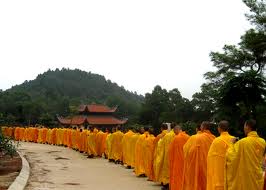 Buddhism is a community organization (Samasambhaga) was born early in human history (in the 5th century BC). It is the Sangha community; Including the laity. This community is collectively referred to as the "Four Sisters" (Bhikkhu, Bhikkhu, Bhikkhuni, Upàsaka, Upàsìka). A community does not build on the principle of submitting to the authority of the god, the leader, the leader, or the law, which is built on the individual's awareness of the six principles of harmony. ), adapting to all the benefits to the individual and benefiting the community.
II. CONTENT:
A. Identification of Harmonization:
Hyun is the six principles of living in harmony, solidarity in the holy love of the community of disciples of the Buddha at home as well as ordained. That is:
- Harmonization: Harmony on the principle of Discipline
- Harmonized: Copper on the principle of Action
- Shreds on the principle of speech
- Harmoniousness: Harmony on the principle of Benefit
- Harmonization agreement: On the basis of volunteering
- Conciliation: Conciliation on the principle of Awareness
B. Interpretation:
1. Harmonization: This first principle implies " Discipline on Discipline"; The community of disciples of the Buddha preserves the Vinaya rules not to be contaminated with defilements for fellow practitioners, both in front of and behind, in order to create mutual affection, mutual respect and harmony. Thus, this principle is seen as the secret of bliss, happiness for the individual and prosperity for the organization. Buddha taught at home to keep the five precepts; As a monk, novices hold 10 sex; Monk holds 250 gender; Bhiksus holds 348 genders, etc.
The goal of the worth of all Buddhas is the spiritual liberation. The path that leads to that goal is the Truth. It helps us purify the soul, the body of truth is liberated. Precepts are a barrier to the protection of human dignity and morality, to prevent wrongdoing, to eliminate evil (evil). Moreover, the precepts of Buddhism are morals, morals; In addition to personal holiness, it is also seen as the principle of sublimation for the social community. According to the inseparable sense of selflessness, Buddhism says that individuals can not be separated from the community and that the community is not individual; Therefore, the purity of the personality is the sublimation and prosperity of the organizing community.
We also know, the country is not law, the country falls; Non-disciplinary organization, organization; non-canonical religion, unconventional religion. Likewise, Buddhism is a community organization that has a strict and strict rule of law, but has a superiority over other social and religious organizations, that is not a Code of Discipline. or a powerful creed by a supreme being, or a certain supreme authoritarian institution, which is considered to be a general agreement of the Buddhist community of disciples. He did not impose on the time of the Buddha, but on the principle of "self-abiding", ie, in fact what caused the instability, unhappiness for the individual and the community, then the Buddha based on which to formulate the Precepts. Therefore, the Vinaya is considered a fence, It is a safe life for the holy life, a holy life, helping all lay Buddhists as well as renouncing the affliction and suffering to escape all the consequences of greed, delusion, ... towards pure, compassionate and intellectual; to bring peace and peace to life. Therefore, all the disciples of the Buddha should be careful, as if it was a boat crossing the sea of the world to liberate the sea.
2. Copper Spirit: This Second Principle means "Concentration on the Principle of Action"; Every activity, behavior in the community of Buddha disciples are united: go together, stay in, eat together, do the same, take breaks, ... not strange style, not bureaucratic style, To be in harmony with others, not to live in isolation, to isolate, to crack, to dissolve feelings of affection for the Dharma, the same both in front and behind, to form Mutual affection, mutual respect, respect and harmony. Thus, this principle is seen in correspondence with the "Compassionate Lady" in the Four Noble Truths, and is also the secret of bliss, happiness for the individual and prosperity for the organization.
3. Avoidance: This third principle means "Peace on the principle of speech "; Always use loving speech, to make true love for the listener: "Do not say filter words that cheat truthful; do not say the words we say we are straight; do not say evil words but say love; do not say the words cause divisions and hatred that say the meaning of construction and reconciliation ... "; Do not break the crack, divert emotional relationship with the dharma, the same subject both in front and behind, ... to form mutual, mutual love, mutual respect and harmony, unanimous arguments The In addition, with the meaning of this Dharma, the Buddha taught in principle to extinguish the controversy (the law of extermination) in a very subtle way; And he also teaches about the assembly of the Sangha, if so, should "Speak as Dhamma and silence as the dharma" (Central Business, Bible Bridge). Here, This third principle is seen in correspondence with the "photographic deity" in the Four Noble Truths. Thus, this principle is seen as the secret of bliss, happiness for the individual and prosperity for the organization.
4. Harmonious Benefit: This fourth principle means "Concentration on the principle of entitlement". With the Dharma practitioners in the traditional organization of the community of disciples of the Buddha, all rights from the material and spiritual are shared equally equally; censure each other, do not measure, calculate; not jealousy, jealousy of the right to win, ...; Especially for the disciple of the disciple of the Buddha lived a life without family, the photo itself, alone on the way chosen, as the inspirational language praised:
"A thousand bowls of rice
The body wants to be far away
Just because of birth and death
Chemistry last month. "
For people who have seen the "five aggregates" is not what the title and interests. As the Dharmakaya, the first Buddha, the Buddha taught, with a true disciple of His, only consider the importance of "legacy" rather than "material inheritance." Thus, several thousand years since the Buddha's passing away, the Sangha of the Buddha has maintained its status as "For the sake of happiness, for the sake of the sake of the world, moral balance for a thousand years ". The discipleship community of the Buddha is the Homelessness Persons, not private. People give up everything, to come to all. In short, "To serve beings is to offer the Buddha." Beneficial here, Buddhism see "benefit rather than self-interest, altruism rather than selfishness (for man rather than yourself)". Therefore, tolerance, sacrifice and service are considered to be characteristic of Buddhism. Here, this fourth nature is seen in correspondence with the "gift of grace" in Four Noble Truths.
5. Harmonization agreement: This fifth principle means "harmony Dong on the principle of Will "; With the Buddha's disciple, not only did there not be an act of aggression against everyone condemned, but also no small thought or thought about the harm to the accepted being . As we all know, the Buddha taught that "the mind is created in the least," or "the mind as the illustration, the power of the cult" (mind as artist, can draw all images). In fact, suffering, happiness, good fortune, evil report, ... in this life are due to pure thought or defilement, enlightenment or confusion. Besides, he further taught: "Before and clinging is the cause of all birth defilements, suffering." Here, the Buddha refers to mental defilements as clouded clouds in the skies of the mind of all of us. If the Buddha is the perfect model of the perfect person of the fullness of compassion, wisdom, and goodness, his disciples are regarded as the nucleus, the seed of rebirth and enlightenment. sprout, fresh and growing non-stop, that piece of fresh soil for berry seeds that germinate is the heart of the land. If this heartland has many weeds of greed, hatred and ignorance, the seeds of compassion and bodhiness, that wisdom can not germinate well. Buddha taught: That wisdom can not germinate well. Buddha taught: That wisdom can not germinate well. Buddha taught:
"In all dharmas" In all dharmas
The mind, the mind, the mind, the mind
If the mind is polluted If the mind is pure
Speech or action Speech or action
Deafness will follow Happiness will follow
Just like the scooter. As the ball does not loose shape.
(The Dharma verses 1-2)
In the community of disciples of the Buddha, the harmony of the will, the mind and the aspirations, the introspective homosexuality of living together is considered to be a matter of great importance. Once a person has renounced his family member to go out, there is more joy than the joy of the French fraternity, sharing sadness and sadness together. Many people say that the people who are monks are cynical, depressed, persecuted, ... are harmless but also disadvantageous for society; Moreover, some people say they are the ones who leave. Buddhist monks are non-productive. However, they know that such people have spent their lives sacrificing their lives, forgetting their personal happiness to keep their moral ideal, to hold the doctrine, to enlighten their life. , such as being considered indifferent, neglected, ..., Is it disadvantageous for society ?! Do not know, inside the door of the Buddha is a world of people day and night efforts to constantly train talented people, bowls of virtue to deserve the master to guide the way heaven. In fact, over the last 3 thousand years, the roof of the temple, the Buddha's door always bear the talents, liberating the national spirit in the beginning of the country, the place to protect the soul of the nation during the time of disorder. . If not the place where the association has a strict educational tradition, how can Vietnamese Buddhism record such brilliant histories? From that, we find that the Buddhist organization is not mass organization, bustling structure, tight department, ...; However, this is a self-conscious, self-conscious, self-conscious mass organization, not compulsory or religious. With self-consciousness, self-responsibility for any good or bad behavior, good or evil created by oneself. Therefore, at this point Buddhism is understood to be a humanist rather than a religious life. Moreover, in the field of religion, Buddhism is the religion of compassion, suffering, spiritual life rather than the religion of divine revelation. If Buddhism is understood as an organization, it is understood to be the organization of those who live the life of mindfulness, wisdom and compassion rather than the usual congregation that aspires to grow up, reach for the octopus dictatorship, dominion, manipulation, competition, suppression, overrun, like all other normal associations. It can be said: "Buddhism is a community of mindful, happy people living in friendship, not to the problems are lost, more losers, ... happy with the joy of the people, sad with the pain of life; can not see the boundary between man and me; No borderline in the form of national territory, family, organization, ... neither the boundaries of ideology and the soul, spreading the immense legal immeasurable immeasurable immediacy.
6. Concise Conciliation: This 6th Principle means "Peace Dong on the principle of Awareness "; The realization of all knowledge, the consolidation of all perceptions in the community of Buddha disciples, not only support each other in material life, but also help each other in the spiritual life of knowledge, knowledge and understanding. Buddhism is seen as the direction of wisdom and compassion; Therefore, even the Buddha, he does not monopolize the truth that he taught: "I am the Buddha, you are the Buddha will be"; Being a Buddha before or after the Buddha is the same meaning is the truth enlightenment, to escape all the miseries of life. All Buddhists always with the intention: "Disciple and all sentient beings are completely Buddhist." This is the ultimate principle of the Four Pillars of Compassion, but is also the most comprehensive of all of these principles in the principle of behavior in the Buddhist community.
III. CONCLUDE:
In general, spirituality is the secret of the noble behavior of an individual, a beautiful way to build community life. The six principles of harmonious living are considered as the first constitution in Buddhism, with a general agreement of openness, freedom and consciousness. I think this principle of life is not just a way of life that is adaptable in every family, school and any social organization. No matter how sociologists apply the modern method of organization, it is impossible to overcome the principles set out above. Twenty-five centuries ago Buddhism had such a modern social spirit. We can not help dwelling on the ability to excel in the manipulation and administration of the Church of the Sangha in a smooth, Self-conscious, especially high democracy. Over the past 3,000 years, the traditional spirit of the Sangha community is still well preserved in the South as well as in the Buddhist tradition.END=NAM MO SHAKYAMUNI BUDDHA.( 3 TIMES ).VIETNAMESE TRANSLATE ENGLISH BY=THICH CHAN TANH.THE MIND OF ENLIGHTENMENT.VIETNAMESE BUDDHIST NUN=GOLDEN LOTUS MONASTERY=AUSTRALIA,SYDNEY.26/10/2017.

No comments:
Post a Comment